


Page 22 - MSU Campus Tour Guide eBook
P. 22
Mahasarakham University Campus Tour Guide 21

5. Palaeontological Research and Education Centre

The Palaeontological Research and Education Centre at Mahasarakham University
honors Thailand’s rich prehistoric past and looks forward to its future. Palaeontology
is a broad discipline which examines modern life on Earth through the magnifying
glass of the prehistoric fossils embedded within it. To determine the structure and
evolution of extinct animals and plants, and the age and conditions of deposition
in the rock strata in which they are found, sheds light upon the origin and evolution
of life itself. Thailand has an excellent record of non-marine Mesozoic environments,
ranging in age from the Triassic to the Cretaceous periods. Small concentrations
of localities throughout the NE of Thailand have yielded abundant fossils, including
plants, invertebrates and vertebrates (with fossils of Mesozoic vertebrates being most
commonly uncovered locally). Since MSU is located right in the center of this region,
a Thai-French team decided to establish the centre here in order to carry out various
research activities and to provide palaeontological education to our university’s
students.
The Palaeontological Research and Education Centre has 3 main parts:

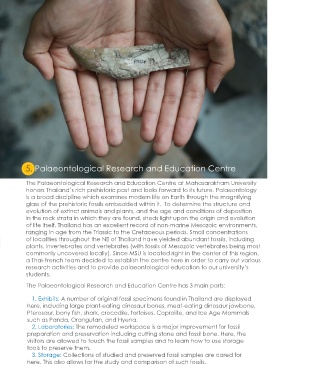
   1. Exhibits: A number of original fossil specimens found in Thailand are displayed
here, including large plant-eating dinosaur bones, meat-eating dinosaur jawbone,
Pterosaur, bony fish, shark, crocodile, tortoises, Coprolite, and Ice Age Mammals
such as Panda, Orangutan, and Hyena.

   2. Laboratories: The remodeled workspace is a major improvement for fossil
preparation and preservation including cutting stone and fossil bone. Here, the
visitors are allowed to touch the fossil samples and to learn how to use storage
tools to preserve them.

   3. Storage: Collections of studied and preserved fossil samples are cared for
here. This also allows for the study and comparison of such fossils.

